I’m an “automate it” person, if it can be automated, it should be. But the reality is…
a lot of shops still need manual blast rooms. When adding a new booth or updating an existing there is a lot to consider. Not sure what type of blast room your operation actually needs?
Download our Blast Room Design Checklist and find out in minutes.
Designing the right blast room involves careful consideration of several factors to ensure efficiency, safety, and quality in your surface preparation processes. Here’s a step-by-step guide to help you design an effective blast room:
1. Determine Your Requirements
A. Type of Blasting
- Shotblasting: Uses spherical media like steel shot for heavy-duty cleaning.
- Sandblasting: Uses angular media like sand or grit for more aggressive surface preparation.
B. Material Types
- Consider the types of materials you will be blasting (e.g., steel, aluminum, composites).
C. Production Volume
- Estimate the volume of work and the size of the components.
2. Space and Layout
A. Room Size
- Ensure the blast room is large enough to accommodate the largest workpiece with sufficient space for operators to move around safely.
B. Doors and Access
- Design doors that allow easy access for loading and unloading large items.
- Consider overhead doors, sliding doors, or roll-up doors.
3. Ventilation and Dust Collection
A. Airflow Design
- Design a ventilation system to provide adequate airflow to remove dust and debris.
- Ensure proper placement of intake and exhaust vents for optimal air movement.
B. Dust Collectors
- Select the right type and size of dust collectors to handle the volume of dust generated.
- Install filters and collection bins for easy maintenance.
4. Lighting and Visibility
- Install bright, explosion-proof lighting to ensure good visibility.
- Use light-colored walls and floors to reflect light and improve visibility.
5. Safety Features
A. Protective Gear
- Provide operators with appropriate protective gear (e.g., helmets, suits, gloves).
B. Emergency Systems
- Install emergency stop buttons and interlocks on doors.
- Ensure fire suppression systems are in place.
6. Media Recovery System
A. Floor Design
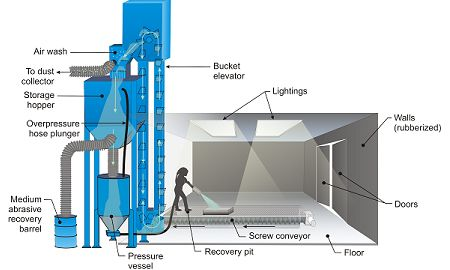
- Choose between a full floor reclaim system, partial floor reclaim, or sweep-in pits.
- Design the floor to collect spent media efficiently.
B. Recycling System
- Install a media recycling system to clean and reuse the abrasive media.
- Include a separation system to remove dust and debris from the reusable media.
Choosing the best blast room recovery system depends on various factors such as the type of abrasive used, the volume of work, budget, and specific application requirements. Here are the main styles of blast room recovery systems, along with their advantages and applications:
Full-Floor Recovery System
Description:
- Utilizes a series of floor gratings that cover the entire blast room floor.
- Spent media falls through the grates and is conveyed to a recovery system via a screw conveyor, pneumatic conveyor, or bucket elevator.
Advantages:
- Maximizes efficiency by recovering media from the entire floor area.
- Reduces the need for manual cleanup.
- Suitable for high-production environments.
Applications:
- Ideal for large-scale operations with continuous blasting.
- Best for applications where the entire blast room floor will be used regularly.
Partial-Floor Recovery System
Description:
- Involves strategically placed floor gratings or trenches, often arranged in a herringbone or U-shaped pattern.
- Media is funneled to the recovery system through these partial areas.
Advantages:
- More cost-effective than full-floor systems.
- Reduces the amount of manual cleanup compared to sweep-in systems.
- Can be customized to the workflow and frequently used areas.
Applications:
- Suitable for medium to high-production environments.
- Ideal for operations where specific areas of the blast room are used more frequently.
Sweep-In Recovery System
Description:
- Involves manually sweeping the spent media into a recovery pit or trench.
- The media is then conveyed to the recovery system.
Advantages:
- Lowest initial cost.
- Simple to implement.
- Allows flexibility in room layout.
Applications:
- Suitable for low to medium production volumes.
- Ideal for smaller operations or where budget constraints are a primary concern.
Pneumatic Recovery System
Description:
- Uses a vacuum system to transport spent media to the recovery system.
- Can be configured as a full-floor, partial-floor, or sweep-in system.
Advantages:
- Effective for lightweight abrasives.
- Can be used to recover media from hard-to-reach areas.
- Reduces the risk of mechanical wear and tear.
Applications:
- Suitable for operations using lightweight abrasives such as glass beads or plastic media.
- Ideal for environments where minimizing dust is crucial.
Mechanical Recovery System
Description:
- Utilizes screw conveyors, bucket elevators, or belt conveyors to transport spent media to the recovery system.
- Can be part of a full-floor or partial-floor recovery system.
Advantages:
- Handles heavy and dense abrasives effectively.
- Provides consistent and reliable media recovery.
- Can be customized to specific application needs.
Applications:
- Suitable for heavy-duty operations using dense abrasives like steel shot or grit.
- Ideal for high-production environments requiring robust recovery systems.
Recovery System Quick Guide
- Full floor → highest efficiency, highest cost
- Partial floor → balance of cost + performance
- Sweep-in → lowest cost, highest labor
- Pneumatic → best for light media
- Mechanical → best for heavy media
Common Blast Room Design Mistakes
- Undersized dust collectors
- Poor airflow direction
- Wrong recovery system for production
- Not planning for maintenance access
- Designing for today, not future growth
Most blast room problems aren’t operational they’re design mistakes made upfront.
What a Poorly Designed Blast Room Costs
- Lost production time
- Higher labor for cleanup
- Increased media consumption
- Faster equipment wear
- Operator frustration
A cheap design upfront often becomes the most expensive system to run. Your blast room doesn’t determine just how parts get cleaned, it determines how efficiently your entire operation runs.
Designing the right blast room requires a balance of functionality, safety, and efficiency. By considering the specific needs of your operation and incorporating the right features, you can create a blast room that enhances productivity and ensures high-quality results. If you need detailed design assistance or specific product recommendations, consulting with LS Ind a blast room specialist who can provide tailored solutions for your requirements.
Where Engineered Blast Rooms Make the Difference
- Proper airflow design
- Correct dust collection sizing
- Right recovery system selection
- Designed for your actual production
This is where custom-engineered systems outperform off-the-shelf solutions. Let’s design one that actually works for your operation. If your blast room was designed without considering airflow, recovery, and production together, it’s probably underperforming.
Melissa Palmer