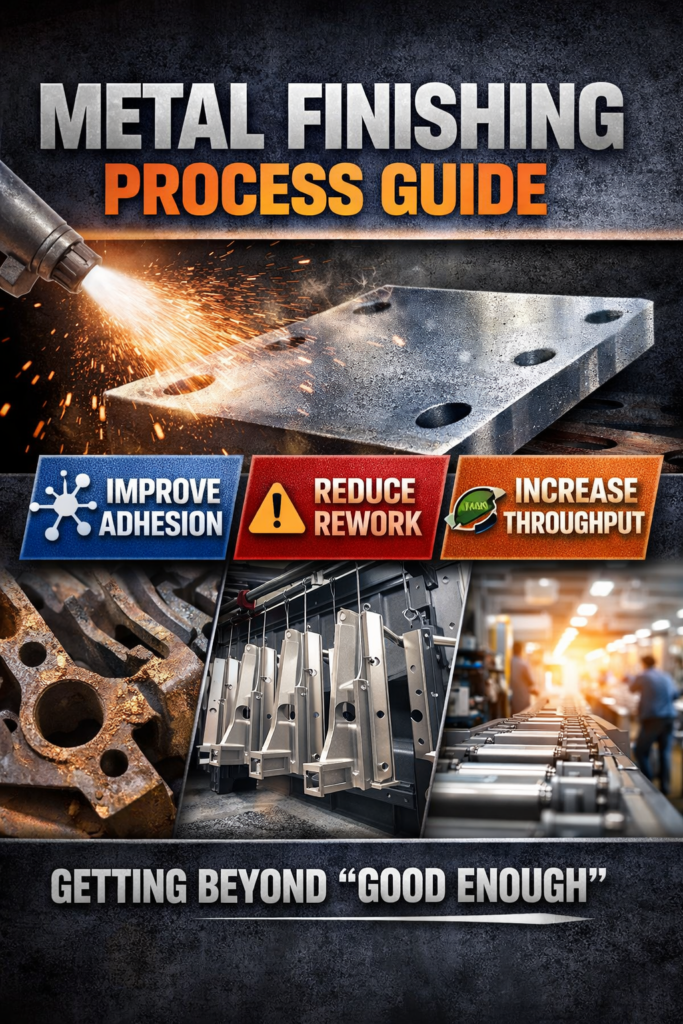
Want to identify where your finishing process is costing you time and money?
Download our Metal Finishing Process Checklist and spot issues in minutes.
When it comes to metal finishing, “good enough” is usually not good enough. Whether you’re prepping for paint, coating, welding, or assembly, surface finish is where quality begins. A bad finish can kill adhesion, ruin appearance, and cause premature corrosion. And in today’s competitive manufacturing world, you don’t get paid for rework. Don’t throw your profits down the drain.
Here’s what separates the pros from the pretenders:
1. Start With the Right Surface Prep – My personal Favorite!
Surface prep isn’t one-size-fits-all. The right method depends on your material, coating, and final use. Blasting, washing, and degreasing are not interchangeable. Each step has its own role:
- Shot or grit blasting removes scale, rust, and old coatings while creating an anchor profile.
- Aqueous washing clears oils, cutting fluids, and particulates.
- Rinsing and drying ensure no contaminants are carried into the paint or coating stage.
Skipping one step to “save time” usually costs triple later. Talk with an expert or do coating testing before selecting the right solution for you.
At LS Industries, we see it every week, shops that were “fighting their paint” but really just needed to fix their prep. Once they install a proper blast, wash, and dry sequence, the difference is night and day.
2. Measure, Don’t Guess. And Keep measuring
Good operators can feel quality, but great ones can prove it. You can’t improve what you don’t measure:
- Check surface profile (Ra/Rz) to match your coating spec.
- Monitor media condition, worn shot or grit leads to inconsistent cleaning and dust buildup.
- Verify chemical concentrations in washers regularly.
A few quick readings with proper gauges can prevent hours of troubleshooting later. Precision finishing is about repeatability, and that starts with data. Every reading you log is one less problem to chase later.
3. Control the Environment
A perfect blast in a damp room will flash-rust before it reaches paint. A clean booth with good airflow and dust collection keeps particles out of coatings and lungs alike. Temperature, humidity, and air quality can undo perfect prep in minutes.
- Keep blast and coating areas clean and dry.
- Use forced-air cooling and dehumidification where needed.
- Don’t overlook airflow, poor dust collection is a silent production killer.
Simple improvements like forced-air cooling, dehumidifiers, or spark-trap dust collectors make massive quality gains with minimal cost. A clean booth equals clean results. Don’t get lazy on preventative maintenance. It is not a one and done.
4. Maintain Your Equipment Like It Matters
Because it does. Your blaster, washer, or oven is only as reliable as your maintenance routine.
- Inspect wear liners, blast wheels, and filters on a schedule not when they fail. Plan ahead to prevent costly downtime.
- Keep washers descaled and properly jetted.
- Calibrate temperature controls on ovens quarterly.
Maintenance isn’t overhead, it’s uptime insurance. Let’s face it nothing costs more than no production for a day due to poor planning.
5. Document and Standardize. Train, Document, and Repeat
Your best operator can’t be everywhere. Turn tribal knowledge into written procedures and visual checks. Consistency drives repeatability, and repeatability drives profit.
Even the best equipment can’t overcome inconsistent operation. Every operator should know:
- Correct setup parameters
- Cleaning and shutdown procedures
- How to recognize poor results before they become expensive problems
6. Use the Right Media and Chemistry
Media choice matters more than most realize.
- Steel shot produces a smoother surface and is recyclable.
- Grit cuts more aggressively for heavy corrosion.
- Glass bead or aluminum oxide may be better for non-ferrous or decorative applications.
7. Don’t Overlook the Cure
Paint or powder quality depends on the cure. Under-curing can lead to soft coatings; over-curing can cause brittleness or discoloration. Regularly verify oven temperature uniformity and airflow patterns especially on larger batch or conveyor systems.
If your finish scratches too easily or fails adhesion tests, start by checking oven zones before blaming your coating supplier. Similarly, your wash chemistry should match your soil load. Overdosing chemicals doesn’t clean faster, it just wastes money and corrodes equipment.
Metal finishing isn’t just about making parts shiny; it’s about protecting the value of what you built. The best shops treat finishing as a precision process, not an afterthought. When blasting, washing, and coating all work in harmony, you get stronger adhesion, cleaner results, and happier customers. Not to ignore more profit and higher return on investment.
If you’re ready to modernize your finishing process, whether that means upgrading a blaster, washer, or oven, let’s talk. That’s what we do every day at LS Industries: building equipment that turns “good enough” into “built to last.”
There’s no shortcut to a great finish. But with the right tools, training, and consistency, you can make “perfect” your new standard.
It’s not the paint. It’s the prep.
What a High-Performing Finishing Process Looks Like
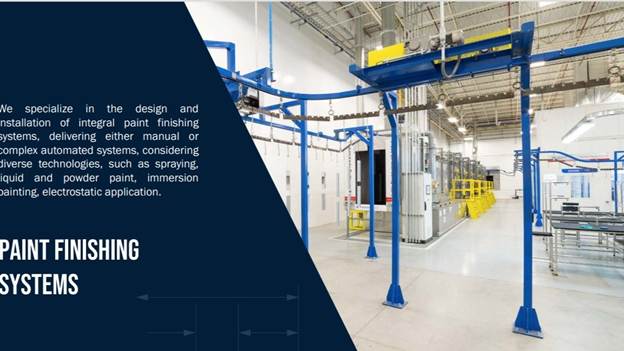
Blast → Wash → Rinse → Dry → Coat → Cure → Cool
Miss one step → problems show up later
Where Most Systems Fall Short
- Incomplete prep integration
- Poor airflow and dust control
- Incorrect equipment sizing
- Lack of process control
This is where engineered systems outperform pieced-together solutions.
Most finishing problems aren’t caused by coatings they’re caused by bad prep that nobody wants to admit.
Melissa Palmer
Sales Manager