When it comes to surface preparation, one of the most common beliefs in the coatings industry is this:
“The rougher the surface, the better the coating sticks.”
Sounds logical, right?
More texture = more grip.
But here’s the reality:
Myth… and Fact.
A properly controlled surface profile absolutely improves coating adhesion.
But an excessively high profile can create coating failures, premature rust, wasted paint, and expensive rework.
In industrial finishing, bigger is not always better. Controlled is better.
What Is Surface Profile?
Surface profile refers to the microscopic peaks and valleys created on a substrate after abrasive blasting.
These peaks and valleys help coatings mechanically bond to the steel surface.
Without profile:
- Coatings may peel or delaminate
- Adhesion strength drops
- Corrosion protection suffers
With the correct profile:
- Coatings anchor properly
- Film build becomes more uniform
- Long-term durability improves
That is why abrasive blasting is critical before painting, powder coating, thermal spray, rubber lining, or specialty coatings.
Why Surface Profile Matters
Think of coating adhesion like pouring concrete around rebar.
Smooth steel gives very little to grab onto. And what you want is for it to grab on tight!
A properly blasted surface creates:
- Increased surface area
- Mechanical anchoring
- Better coating wet-out
- Improved corrosion resistance
This is especially critical in:
- Structural steel
- Oil & gas
- Marine
- Military equipment
- Heavy fabrication
- Transportation
- Bridge and infrastructure work
The Problem With “More Profile Is Better”
Here’s where the myth starts to fall apart.
If the surface profile becomes too deep:
- Coatings may not fully cover the valleys
- Sharp peaks can protrude through the coating
- Premature rusting can begin at peak locations
- Paint consumption skyrockets
- Cure consistency suffers
- Thin-film areas become weak points
The result?
You may spend more money blasting harder and using more coating… while actually reducing coating life.
That’s a brutal tradeoff.
The Real Goal: Match the Profile to the Coating System
Different coating systems require different surface profiles.
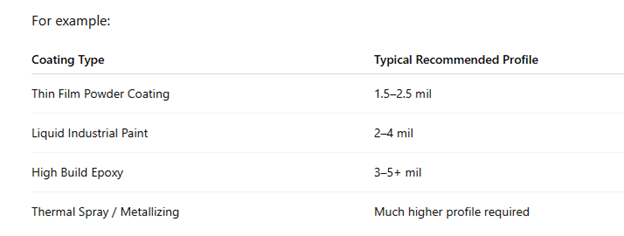
The coating manufacturer’s TDS (Technical Data Sheet) should always drive the target profile.
Not guesswork.
Not “more aggressive blasting because it feels better.”
CASE STUDY: When More Aggressive Blasting Hurt Coating Performance
A heavy fabrication customer processing structural steel beams believed they needed an extremely aggressive blast profile to improve paint adhesion for an outdoor coating system.
Their process used:
- Large angular steel grit
- High wheel horsepower
- Slow conveyor speed
- Extremely aggressive blast pattern
Initially, the parts looked excellent visually. The steel had a deep anchor profile and a very “white metal” appearance.
But several issues began appearing:
- Paint usage increased dramatically
- Coating thickness became inconsistent
- Sharp profile peaks created premature rust spotting
- Additional coating passes were required to achieve coverage
- Production throughput slowed down
After evaluating the process, the blasting system was adjusted to:
- A more controlled abrasive blend
- Optimized wheel angles
- Reduced blast aggression
- A target profile matched to the coating manufacturer specification
The Results
After optimizing the profile:
- Paint consumption dropped
- Coating coverage became more consistent
- Throughput increased
- Rework decreased
- Coating adhesion still met specification
- Overall finishing costs improved significantly
The biggest takeaway?
The customer learned they did not need the highest profile possible.
They needed the correct profile for the coating system.
That difference saved both time and money.
What Determines Surface Profile?
Several factors affect the final anchor pattern:
Abrasive Type
Angular abrasives create sharper profiles. Rounded media produces smoother finishes.
Examples:
- Steel grit = aggressive profile
- Steel shot = smoother peened finish
- Garnet = angular cut
- Aluminum oxide = aggressive cut
Abrasive Size
Larger abrasive generally creates deeper profile.
Blast Pressure & Wheel Horsepower
Higher energy increases surface impact.
Substrate Hardness
Harder steel profiles are different than softer materials.
Blast Distance & Angle
Improper blasting technique can create inconsistent profile across parts.
Why Consistency Matters More Than Aggression
One of the biggest issues in coating failures is inconsistent surface prep.
A surface with:
- Uneven profile,
- Contaminated steel,
- Trapped dust,
- Or random blast patterns
Can destroy coating performance even if the average profile “looks okay.”
That’s why automated blasting systems are becoming more important across manufacturing.
Modern automated systems help achieve:
- Repeatable profile
- Consistent coverage
- Controlled blast intensity
- Reduced operator variability
- Better coating performance
- Lower abrasive consumption
In industries where coating failure is extremely expensive, consistency wins every time.
Measuring Surface Profile Correctly
You cannot reliably judge profile by eye.
Proper measurement methods include:
- Replica tape
- Surface profile gauges
- Digital profilometers
- Comparator standards
Many coating failures happen because shops assume they are hitting spec when they are not.
“Looks blasted” is not a specification.
Surface Prep and Coating Adhesion Go Hand in Hand
A great coating applied over poor surface prep is still a poor system.
In fact, many coating experts will tell you:
Surface preparation is often more important than the coating itself.
That may sting a little for the paint side of the industry… but they are not wrong.
Final Verdict: Myth or Fact?
FACT:
A proper surface profile improves coating adhesion.
MYTH:
Higher and more aggressive profile always means better adhesion.
The real key is achieving the correct, controlled, and repeatable profile for the specific coating system being applied.
That is where performance, durability, and ROI are won.
Why It Matters for Manufacturers
Incorrect surface profile can lead to:
- Premature coating failure
- Warranty claims
- Rust bleed-through
- Excess paint usage
- Rework labor
- Production slowdowns
A properly engineered blasting process helps manufacturers:
- Improve coating life
- Reduce paint consumption
- Increase consistency
- Improve throughput
- Reduce operator dependency
And in today’s manufacturing environment, consistency is king.
Melissa Palmer – Sales Manager