Industry
Data Center Infrastructure Manufacturing
Application
Large fabricated enclosures, generator components, structural frames, battery backup systems, and cooling infrastructure requiring corrosion-resistant industrial coatings.
The Challenge
A growing data center equipment manufacturer was struggling to keep up with production demand using a traditional manual finishing process.
Their operation relied heavily on:
- Manual blasting
- Forklift movement between departments
- Hand spray painting
- Inconsistent coating quality
- Labor-intensive material handling
As demand for data center infrastructure exploded, the finishing department became a major production bottleneck.
The company faced several challenges:
- Labor shortages
- Inconsistent coating thickness
- Difficulty maintaining throughput
- Rising rework costs
- Excessive WIP inventory
- Operator fatigue
- Safety concerns from repeated material handling
Even worse: large fabricated parts often sat waiting between blast, paint, and cure operations, slowing the entire manufacturing process.
The Goal
The manufacturer needed a scalable finishing solution that could:
- Increase throughput
- Improve coating consistency
- Reduce labor dependency
- Improve safety
- Reduce handling damage
- Support future production growth
Most importantly: they needed a system built for continuous flow manufacturing.
The LS Industries Solution
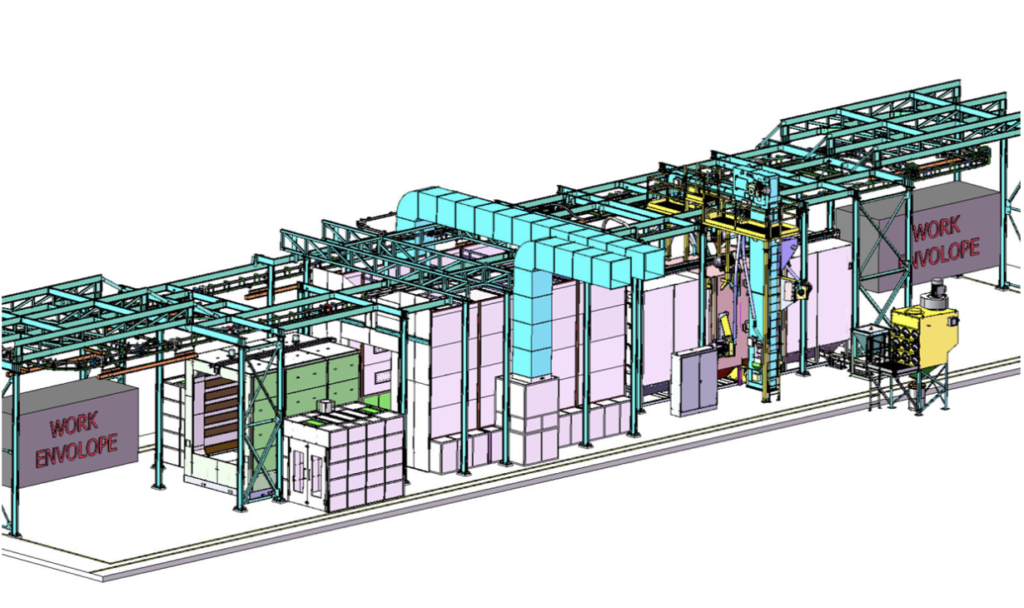
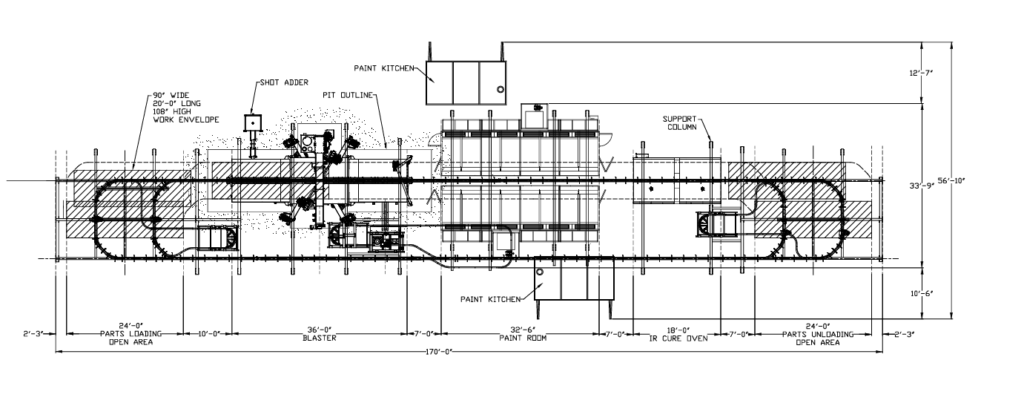
LS Industries designed and integrated a complete automated monorail finishing system featuring:
Integrated Monorail Conveyor System
Providing continuous part flow through the entire finishing process.
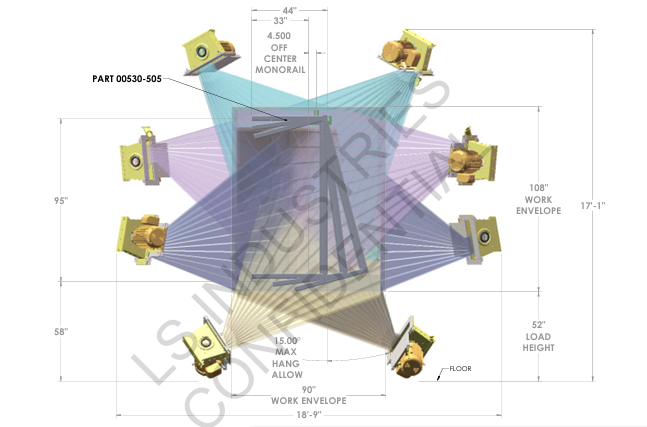
Automated Shot Blasting
Creating repeatable surface preparation and coating adhesion.
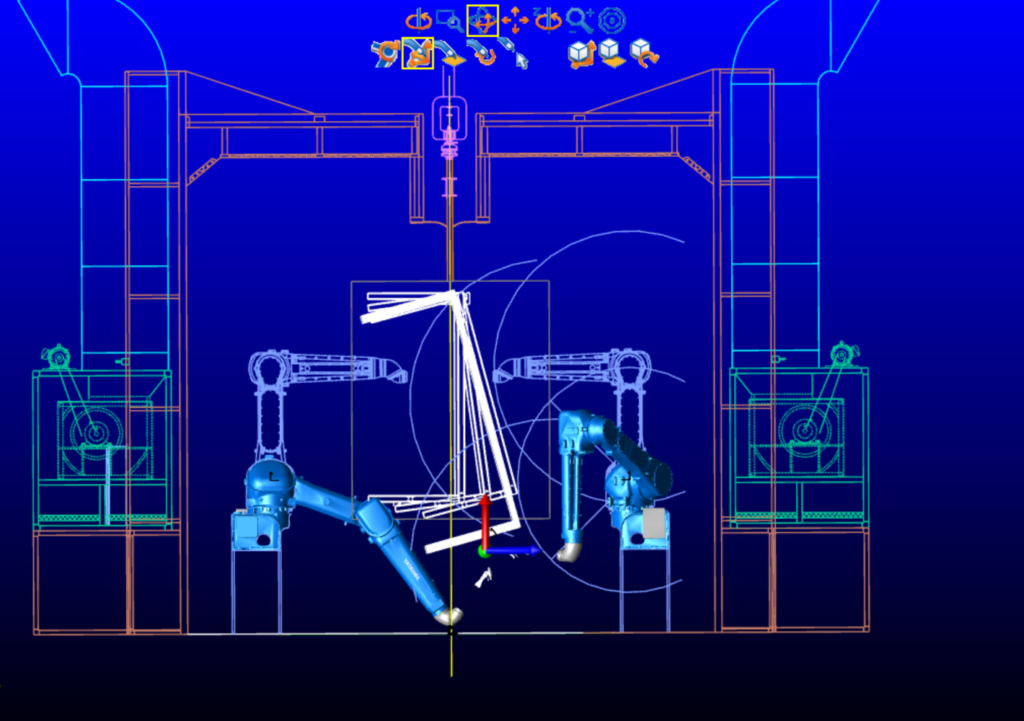
Robotic Spray Coating System
Delivering consistent film build and improved transfer efficiency.
Integrated Cure Oven
Ensuring controlled cure cycles and repeatable finish quality.
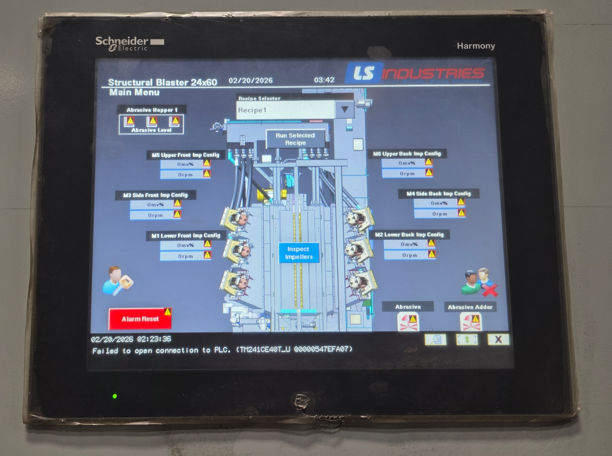
Centralized Controls & Automation
Allowing operators to monitor and control the full finishing line from a unified system.
Before Automation
Manual Process Problems
- Multiple forklift transfers per part
- High labor dependency
- Inconsistent spray patterns
- Variable blast quality
- Excessive touch labor
- Long production queues
- Rework from coating inconsistency
- Operator fatigue and ergonomic concerns
Production scheduling became increasingly difficult as demand increased.
After Automation
Once the automated monorail system was installed, the improvements were immediate.
Results Achieved
Up to 45% Increase in Throughput
Continuous part flow dramatically reduced idle production time.
Reduced Manual Labor Requirements
Operators shifted from repetitive manual blasting and spraying to higher-value production oversight.
Improved Coating Consistency
Robotic spray automation created: Especially on a well surface prepped part.
- repeatable film thickness
- better edge coverage
- reduced overspray
- improved finish appearance
Look at that blast coverage!
Reduced Rework
Consistent blasting and robotic application significantly reduced coating defects and touch-up labor.
Improved Material Flow
The monorail system reduced forklift traffic and unnecessary handling throughout the finishing department.
Better Workplace Safety
Reduced manual handling and repetitive blasting/spraying tasks improved ergonomics and operator safety.
Increased Production Visibility
Integrated controls provided better scheduling, tracking, and process management across the line.
Why the Robotic Spray System Mattered
One of the biggest improvements came from robotic coating automation.
Compared to manual spraying, the robotic system provided:
- more consistent gun distance
- repeatable overlap patterns
- controlled application speed
- improved transfer efficiency
- predictable coating thickness
This reduced:
- paint waste
- operator variability
- coating inconsistency
- long-term quality issues
In high-volume manufacturing, consistency becomes profitability.
Why the Monorail Changed Everything
Before automation: parts stopped constantly.
After automation: parts flowed continuously.
That shift alone transformed production efficiency.
The monorail system helped eliminate:
- unnecessary handling
- staging delays
- forklift congestion
- production bottlenecks
- slow drying process
The result was a cleaner, faster, and more scalable finishing operation.
Final Outcome
The manufacturer successfully transformed finishing from a labor-heavy bottleneck into a scalable automated production process.
The new system allowed them to:
- support growing demand
- improve finish quality
- reduce labor dependency
- improve throughput
- increase operational consistency
And in today’s manufacturing environment, those advantages matter more than ever.
Key Takeaway
Manual finishing can only scale so far.
When production demand rises, automation becomes more than an upgrade: it becomes a competitive advantage.
LS Industries helps manufacturers integrate:
- blasting
- washing
- coating
- curing
- handling
- robotics
- controls
Into one continuous finishing solution. One Stop Solutions with zero finger pointing.
We want to help you with your production! Call us
Melissa Palmer – Sales Manager