Not sure which method is right for your parts?
Ask about our free Zinc Removal Process Guide and compare methods side-by-side.
In metal finishing, there are plenty of tasks that look simple from the outside… until you try to do them with the wrong equipment. Removing zinc, whether it’s galvanizing, zinc plating, zinc-rich coatings, or contamination is one of those tasks.
Every week, I hear something like: “Can’t we just run it through the washer and strip the zinc off?”
Short answer? Nope.
Zinc doesn’t care about your standard alkaline detergent, your spray pressure, or your tank size. It’s a chemically resistant coating and removing it requires a very specific setup or you’ll destroy parts, wreck equipment, and violate more EPA rules than you want to think about.
Here’s what manufacturers, rebuilders, and metal shops REALLY need to know.
Part 1: Why Zinc Removal Is Different
1. Zinc Removal Requires the Right Chemistry Not Just a Hot Wash
A normal parts washer is built to remove oils, greases, cutting fluids, and general grime. Zinc removal takes chemistry:
🔹 Acid-based zinc strippers 🔹 Alkaline zinc removal blends 🔹 Chelating agents for high-value components
If you’re not using the right solution, nothing happens. If you use the wrong one, you’ll eat base metal faster than the zinc.
2. Your Washer’s Construction Matters More Than You Think
Running aggressive chemistry through a mild-steel washer is the fastest way to buy yourself a new one. Zinc strippers require:
✔ Stainless steel tanks ✔ Acid-resistant pumps & seals ✔ Stainless spray manifolds ✔ Proper venting ✔ Correct material compatibility
Most off-the-shelf washers are simply not built for this; you will need something designed for the specific task.
3. Heat, Agitation & Pressure Speed Everything Up
Zinc doesn’t magically lift because you turned the temperature knob to “high.”
Effective removal often needs:
- Elevated but controlled heat
- High-pressure spray
- Rotating tables / baskets
- Ultrasonic energy for complex parts
In other words: mechanical energy + chemical energy.
4. Zinc Stripping Creates Hazardous Waste (Yes Legally)
This is the part many shops forget about.
Once you dissolve zinc into the bath, the waste becomes a heavy-metal-bearing hazardous material under EPA code D007.
You cannot: ❌ Dump it ❌ Evaporate it ❌ Pretend it didn’t happen
You need: ✔ Neutralization ✔ Precipitation ✔ Proper disposal ✔ Documentation
Skipping this is a fast track to fines.
5. Ventilation Isn’t Optional
Zinc stripping especially with heated acids produces fumes that must be controlled.
If your washer doesn’t have:
- A dedicated exhaust
- Mist/fume control
- Correct airflow
- Proper PPE protocols
Then it’s not ready for zinc removal.
So, What DOES a Washer Need to Safely Remove Zinc?
To do it correctly, you need:
🔧 Zinc-stripping chemistry 🔧 Stainless or fully compatible construction 🔧 Proper venting 🔧 Heat & agitation 🔧 pH monitoring & bath control 🔧 Hazardous waste handling 🔧 Trained operators
This isn’t “just washing” it’s chemical processing.
The Bottom Line
Zinc is stubborn for a reason it’s meant to protect the steel underneath. Removing it effectively and safely requires the right equipment, the right chemistry, and a process built for heavy metal stripping.
If your shop is dealing with zinc removal, galvanizing prep, refurb work, or part reconditioning, don’t assume a standard parts washer will get the job done.
There are systems engineered for this. There are washers built with the right materials. And there are chemical processes designed to do it safely and repeatably.
If you want help understanding what your application really needs or you’re quoting a customer that “just wants to strip the zinc off” I’m happy to walk you through the right approach.
IS THERE A BETTER WAY THEN A SPRAY WASHER?
Part 2: What Actually Works (Methods)
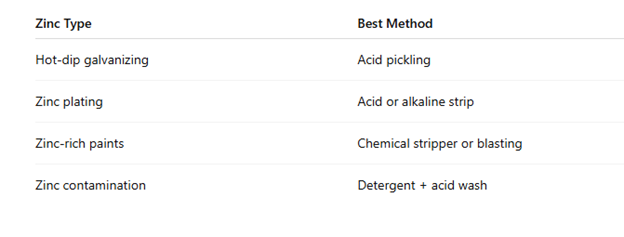
Yes, WAY better ways than a spray washer, especially depending on the type of zinc you’re trying to remove (galvanizing vs zinc plate vs zinc-rich coatings). Washers can do it with the right chemistry, but they’re rarely the fastest, safest, or most cost-effective method.
Here’s the straight rundown no fluff because I prefer to tell it like it is.
1. Acid Pickling (Hydrochloric or Sulfuric) The Most Common
If you’re removing hot-dip galvanizing or zinc plating, nothing beats a proper acid pickling tank.
Why it’s better than a washer:
- Fast
- Cheap per cycle
- Can handle large/odd shapes
- Easily controlled chemically
- Used in nearly every galvanizing shop
What you need:
- Poly or FRP pickling tank
- Ventilation
- Acid-resistant hoist
- Neutralization plan
This is the industry standard for stripping zinc.
2. Caustic (Alkaline) Stripping – Safer Than Acids
Used when acids might attack the base metal or when environmental controls are stricter.
Works well for:
- Zinc plating
- Thin zinc coatings
- Small precision parts
Pros:
- Lower fume risk
- Less aggressive on steel
Cons:
- Slower
- Still produces hazardous zinc waste
3. Media Blasting – Only for Thin Zinc
You can blast zinc off, but:
It only works for:
- Thin zinc plating
- Light galvanizing
- Parts that tolerate aggressive abrasion
Downsides:
- Not efficient for heavy galvanizing
- Creates dust control issues
- Expensive (labor + media + wear parts)
If the zinc is thick → blasting becomes painfully slow.
4. Burn-Off Ovens (Selective Use Only)
Warning: Zinc produces zinc oxide fumes when heated → hazardous.
Only used when:
- The zinc amount is minimal
- The temperature stays below zinc vaporization threshold
- There’s proper afterburner + emissions control
Generally, NOT the recommended method.
5. Grinders / Mechanical Removal (Small Areas Only)
Manual or automated grinding is used when:
- You’re just removing zinc from weld zones
- You need local removal, not full stripping
Great for:
- Fabrication shops
- Prepping galvanized steel for welding
Not practical for entire parts.
❌ Methods That Do NOT Work
- Standard hot wash detergent
- Solvents
- Pressure washers
- Cold alkaline cleaners
- Shot blasting for heavy zinc
These will waste time and wreck equipment.
⭐ Best Overall Method (Industry Standard)
Acid pickling
Fastest. Cheapest. Most controllable. Used by galvanizers worldwide.
If you’re removing zinc:
Hope this helps you find the right method for you. Wanting additional help, let’s talk
What Zinc Removal Costs You (When Done Wrong)
- Destroyed equipment
- Chemical waste disposal costs
- Rework from incomplete removal
- OSHA / EPA risk
Zinc removal done wrong doesn’t just fail, it gets expensive fast.
Where Engineered Systems Matter
- Chemical compatibility
- Controlled process
- Integrated ventilation
- Waste handling support
This is where standard washers fail and engineered systems win.
Melissa Palmer, Sales Manager